Bulky and furniture warehouses: big spans, floor stacks and fragile giants
How a bulky-goods and furniture warehouse runs: why span matters more than height, floor stacks mixed with low racks, clamp trucks and flat carts, how sofas, mattresses and stone tops are stored, and where the damage really happens.
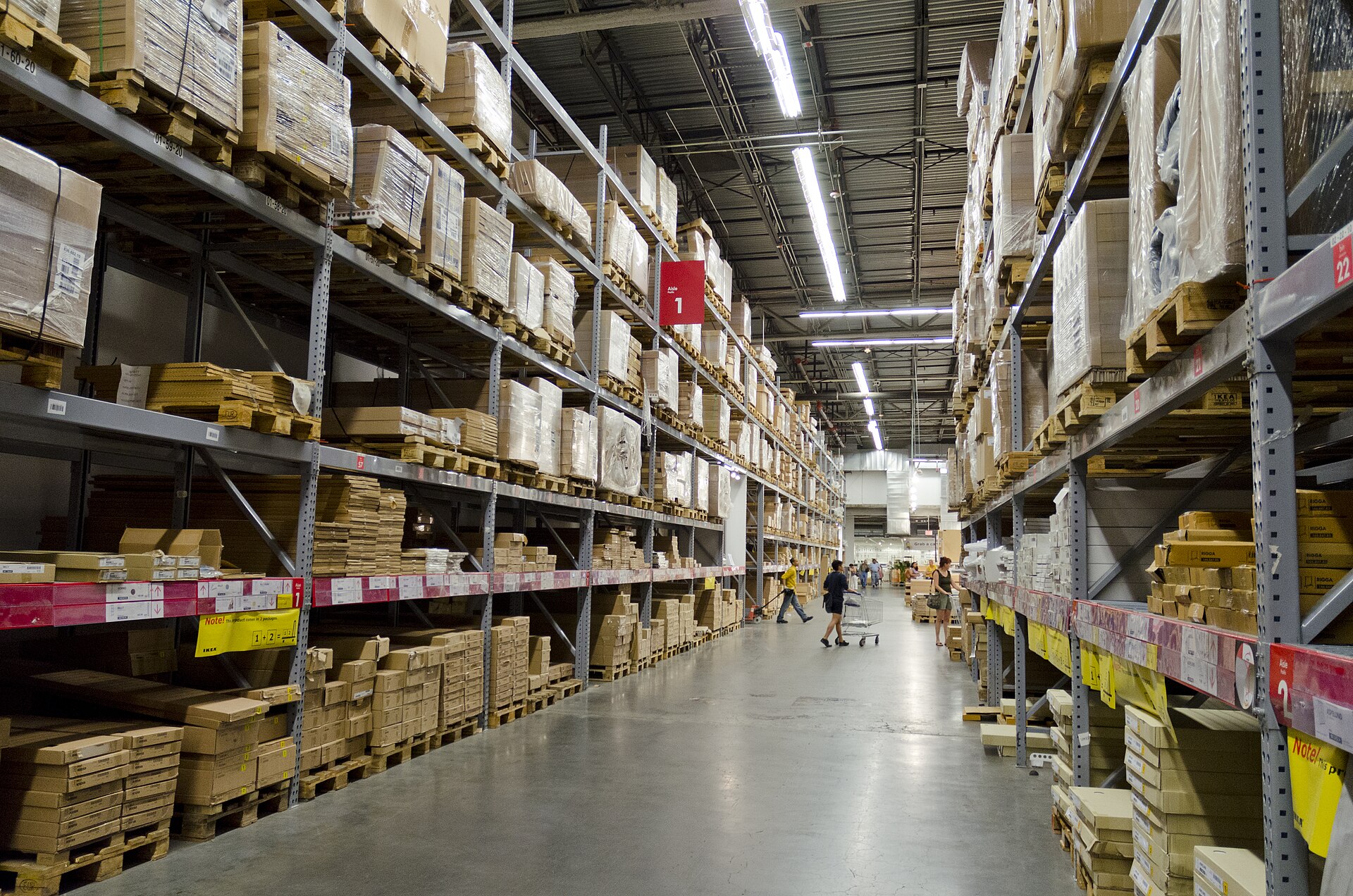
A furniture warehouse holds the goods that break every normal assumption. A sofa is light but takes the space of forty shoe boxes. A mattress cannot be folded, stacked high or leaned on. A stone table top is one hard knock away from scrap at any moment of its life in the building. Orders are often one piece — one sofa, one bed — so there is no “pick twelve small units” rhythm to hide behind; every single move is a two-person, watch-the-corners event. If an e-commerce warehouse is a game of speed, a bulky warehouse is a game of space and gentleness.
What makes a bulky warehouse different#
Start with the building. Bulky goods do not need great height — a sofa on a top beam is a handling accident waiting to happen — they need span: wide, column-free floor where a three-metre sofa, a turning forklift and two people can all move at once. Aisles are wider than in a carton warehouse, turning circles are bigger, and a large share of the stock never touches a rack at all: it lives in floor stacks. The racking that does exist is mostly low — two or three beam levels — because the goods themselves are the height of each level. The cost metric flips too: carton warehouses count cost per pallet position; bulky warehouses count cost per cubic metre actually filled, because air is what you mostly store.
| Side by side | Carton e-commerce warehouse | Bulky / furniture warehouse |
|---|---|---|
| Building | Height is money: rack as high as the trucks allow | Span is money: wide column-free floor, low racks of 2–3 levels |
| Storage | Pallets and bins on racks, one SKU per slot | Floor stacks plus low racks; pieces leaned, laid or A-framed by shape |
| Handling | Forklifts, pallet jacks, one person per task | Clamp trucks, flat carts, furniture dollies; two people is the default crew |
| Main risk | Wrong item, wrong quantity — errors of information | Damage — corners crushed, surfaces scratched, stone cracked. Errors of contact |
Because shape decides everything, bulky locations are modelled by size in Docklify. When a location is created (WMS → Locations), its length, width and height can be recorded, along with how pallets sit in it — so a 2.4-metre sofa slot and a standard pallet slot are different things in the system, not just on the floor. Floor-stack areas get real location codes too, created as storage locations for the standing stock and staging locations for the areas in front of the docks, so a floor pile is an address someone can be sent to, not “the stack near door 2”.
Storage: floor stacks mixed with low racks#
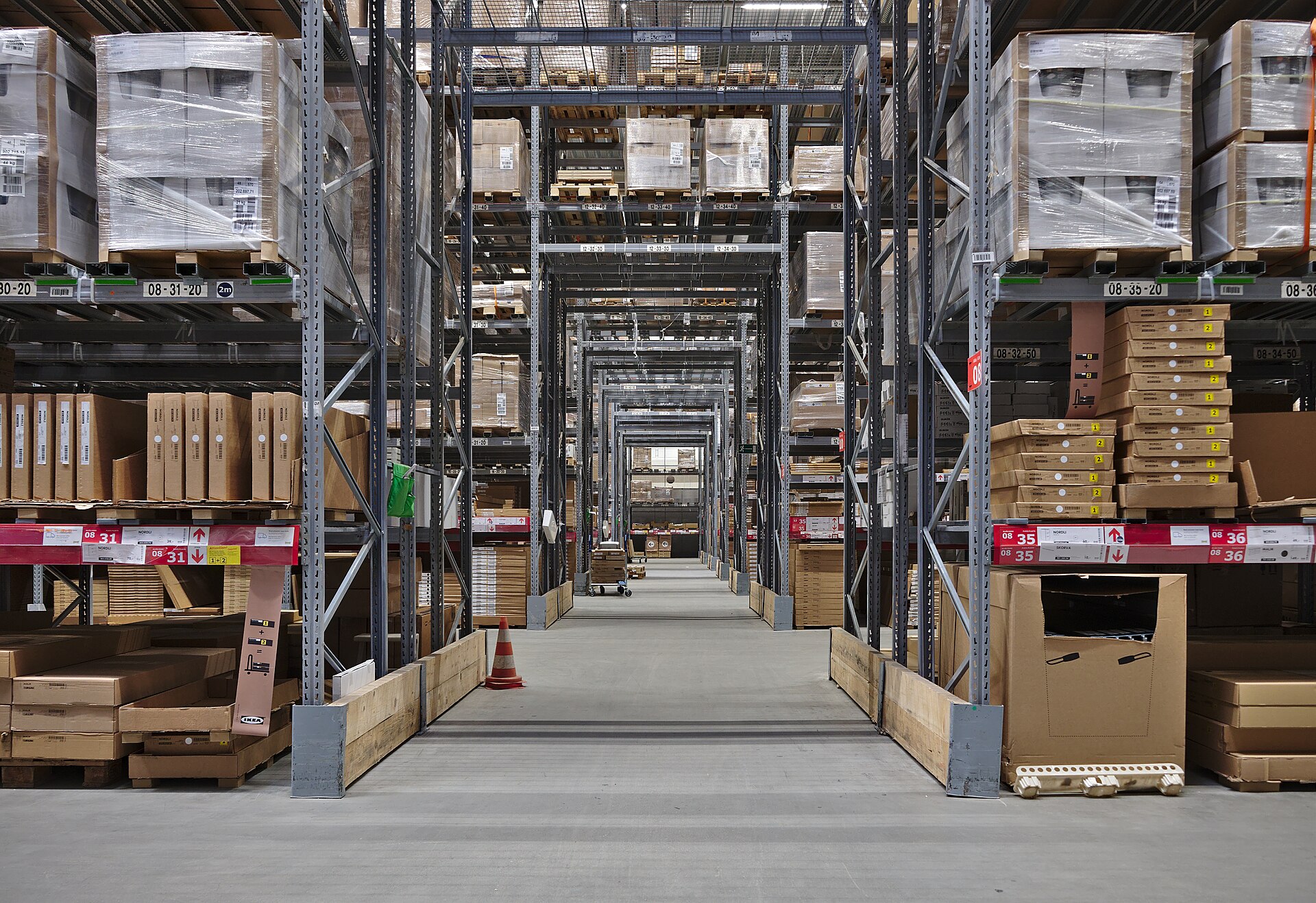
Floor stacking is not the absence of a system; done well it is a system. Stacks are grouped by product family — sofas with sofas, bed frames with bed frames — and each stack is one product, one face out, with its label readable from the aisle. Aisles between stacks are sized for the longest piece that has to come out, not the average one. Low racks take the flat and the regular: flat-pack cartons, boxed chairs, spare parts. Special shapes get special furniture of their own: panels and glass lean on A-frames at a slight angle, never flat-stacked under weight; mattresses stand on their long edge in bays that keep them upright without bending. The rule that ties it together: nothing leans on a saleable surface, and nothing saleable carries weight it was not designed for.
The special areas deserve names in the system as well. In Docklify, the A-frame bay for stone tops, the mattress bay and the fragile-goods corner can be set up as Location Groups (WMS → Location Groups) over the locations that physically form them. Put-away thinking then follows the groups: stone only goes to the stone group, mattresses only to the mattress bay group, instead of depending on whoever is driving remembering where “the careful corner” is this month.
Handling kit: clamp trucks, flat carts and two pairs of hands#
Forks are the wrong tool for much of this freight: they poke through cartons and cannot grip a fabric sofa. The clamp truck is the bulky warehouse’s signature machine — two flat arms squeeze the sides of a carton or an appliance box and lift it without a pallet. Clamp pressure is a setting, not a talent: too loose drops the piece, too tight crushes the corners of the box and the product inside, so each product family gets a pressure the operator dials in. For floor-level moves, flat deck carts and furniture dollies do the quiet work: a sofa rides a dolly instead of being dragged, and dragging is the one unforgivable word in this building — it eats castors, tears packaging and grinds dust into fabric.
- Two people for anything long, tall or over one person’s safe lift — no hero lifts. The second person is not help, they are the corner-watcher.
- Carry by the frame, never by the fabric, the legs or the glass. If a piece has no safe grip points, it rides a cart or a clamp — hands do not improvise.
- Corners get protection before movement, not after damage: corner boards, blankets and stretch wrap go on at the storage face, so the piece travels dressed.
- Routes are walked empty first: measure the tight door, the ramp and the lift with the longest piece in mind before the piece itself arrives there.
Odd shapes: how sofas, mattresses and stone tops are put down#
Sofas travel wrapped and stay wrapped until the customer’s room. In storage they sit flat on their feet or on a low deck, never balanced on an armrest, and nothing is ever stacked on top of the cushions — a weekend under a carton writes a permanent dent. Mattresses are the opposite problem: light, huge and allergic to bending. They stand on the long edge in mattress bays, supported so they cannot bow; a mattress stored folded or sagging between two points comes out with a memory of it. Stone and glass tops live on A-frames, near vertical, edge-protected, one top per slot where possible — flat-stacking stone is how you turn five tops into one top and a pile of gravel. Worktops and table leaves in cartons go flat only when the carton is rated for it, with the weight spread and the “this side up” treated as law.
- Never stack on upholstery. Cushions, fabric and leather are surfaces, not shelves — the stack that saves five minutes costs a sofa.
- Stone and glass move vertical, arrive vertical, store vertical. The one flat moment they are allowed is on the customer’s frame.
- Mattresses never bend, fold or lean at an angle for “just tonight”. Tonight is how a mattress learns a curve.
- Hardware bags are part of the product. The screws, legs and instructions that ship with a flat-pack are taped to the piece or stored with it by location — a wardrobe without its fittings bag is an unfinished product, not a nearly finished one.
Size decides the crew and the vehicle before the order ever reaches the floor — and in Docklify the warehouse says what “big” means. Under Master Data → Warehouses, the Oversize Definition sets four thresholds: a per-piece weight, a longest-side length, a girth, and a whole-order weight. When an outbound order is created or changed, the system checks its lines against those thresholds and flags the order is_oversize automatically, shown in the Order Attributes area of the order. The orders list and the wave filters can pick oversize orders out, so a two-person crew, a clamp truck and the right vehicle are planned from the flag — not discovered at the rack face.
Picking and checking: one piece is one event#
Picking a sofa is not picking multiplied by size; it is a different job. The pair goes to the location together, frees the piece without dragging its neighbours, wraps or re-wraps it, and moves it once to the staging slot for its order — every extra set-down is another chance to catch a corner. Checking is mostly eyes, not scans: walk the piece, look at all four corners, the faces and the feet, open the carton where the carton looks hurt, and photograph damage before the piece moves, not after an argument starts. A big piece with a crushed corner that ships anyway becomes a returned big piece, which is the most expensive sentence in this business.
In Docklify the big work is separated before it starts: the outbound orders list carries the Oversize attribute filter, and Wave Pick can be filtered to oversize orders, so bulky orders are waved, crewed and timed as their own runs instead of being mixed into a small-parcel wave where every piece waits for a sofa to be wrestled out. The Order Attributes area on each order shows the flag and the piece counts the crew lead needs for planning.
Where the damage actually happens#
- Fork tips through cartons. A forklift used on goods that should be clamped writes two neat holes in the box — and sometimes in the product. Wrong tool is the number one damage cause in furniture warehouses.
- Crushed corners in the stack. A heavy carton corner parked on a softer box below slowly folds it. Corners carry stacks; faces never do — and the bottom piece of a bad stack fails on the truck, not in the aisle.
- The drag. One person, one heavy piece, thirty metres of floor. Dragging tears packaging, grinds feet and castors, and writes scratches the customer finds first. If it cannot ride, it waits for the second person.
- Squeeze damage in the truck. Pieces loaded tight without blankets or straps arrive polished against each other — literally: vibration rubs fabric and lacquer for the whole journey.
- The return trip. A returned piece handled like forward stock gets its second injury on the way back in. Returns are inspected at the door and travel on their own path — see below.
Prevention is cheaper than every claim: protect corners at the storage face, pad and strap in the truck, and keep a photo habit at check time. Damage that is found in the warehouse is a handling problem to fix the same day; damage that is found by the customer is a refund, a return trip for a three-metre sofa, and a review with photographs.
Loading: big and heavy first, fragile protected, delivery order reversed#
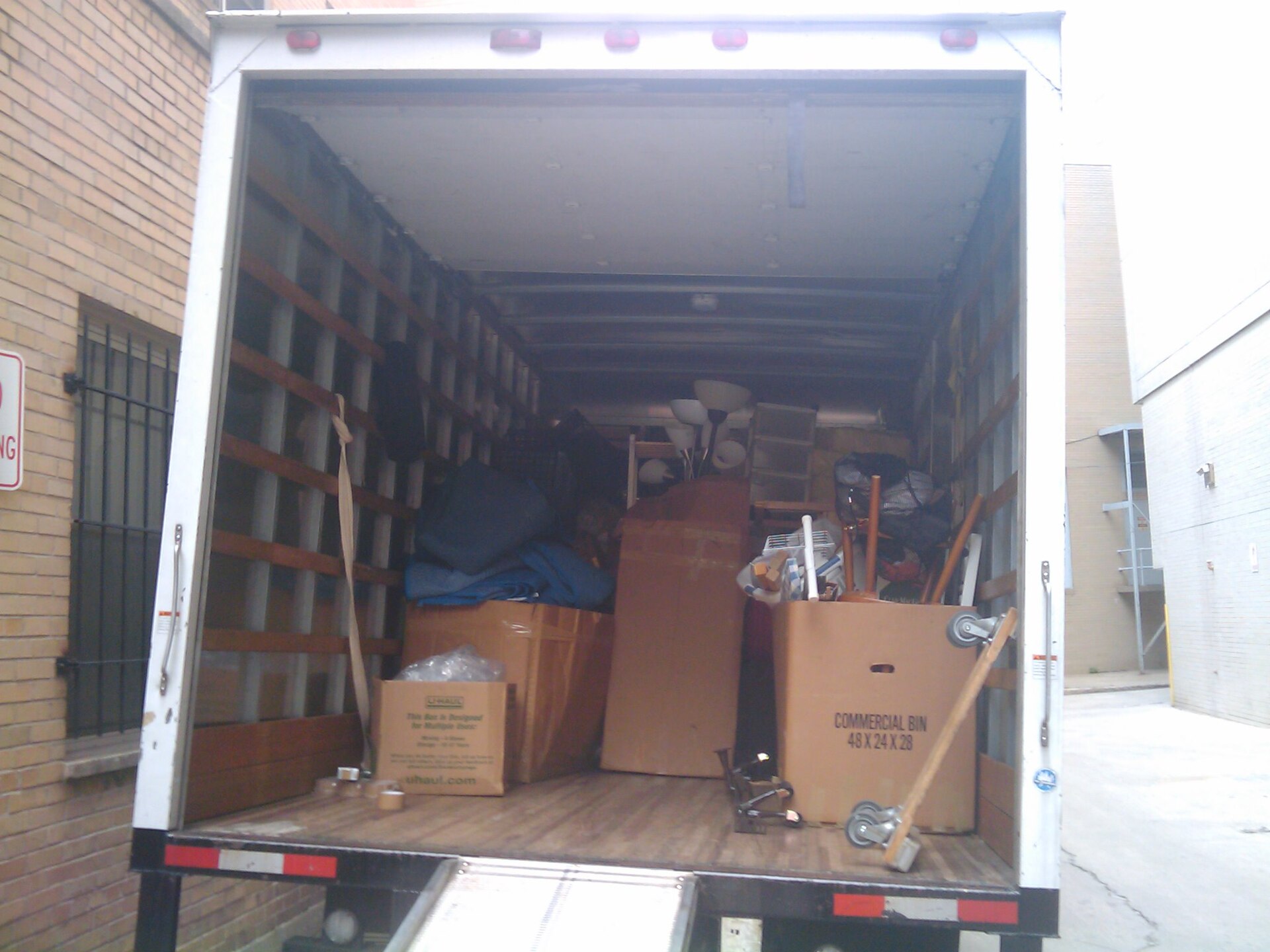
A furniture truck is packed like a puzzle that must come apart in order. The frame of the load is the biggest, heaviest pieces, placed first against the front wall and sides: wardrobes, bed frames, stone tops on their A-frame. Sofas ride on their feet or backs with blankets between every contact surface; mattresses go in vertical, late, where nothing will lean on them; small cartons fill the honesty gaps — the small spaces — never used as cushions under a wardrobe. Straps hold the load as one body, so braking does not rearrange it. And the whole plan runs against the delivery order: the last delivery is loaded first, deepest in the truck, so the crew never has to unload a street’s worth of furniture to reach the first customer’s sofa.
In Docklify, a truckload is organised as a Load document (WMS → Loads): several outbound orders are combined into one load, and recurring routes can be built by template import instead of order by order. For bulky work this is where the load plan lives — which orders share the truck, in which sequence — so the loading crew works from the same list the driver will deliver from, and a piece loaded for the wrong truck shows up as a list error before it becomes a road error.
Returns: the most expensive trip a sofa makes#
A bulky return costs the delivery twice: out, back, and then the handling to decide what it is now. Returned pieces are collected, brought back and inspected at a returns bench — not waved into storage. Inspection grades the piece: resale as new, resale as graded or refurbished, spare parts, or disposal. Only the first grade re-enters normal stock, and only after re-wrapping. In Docklify, returns receiving and inspection run in RMS (SaaS → RMS), separate from forward stock: a returned sofa follows its disposition path there, and only an explicit decision puts it back into sellable inventory — the floor rule and the system rule are the same sentence.
A bulky warehouse runs on respect for volume and surfaces. Give big pieces room to turn, a named place to stand, the right tool to move and a second pair of hands — and most of what this article warns about simply stops happening. The warehouses that lose money on furniture rarely lose it on rent; they lose it one corner, one drag and one squeezed truck at a time.
Docklify features used in this article#
- Locations modelled by size — length, width, height and pallet layout recorded on the location — plus storage and staging location types for floor-stack areas — WMS → Locations
- Location Groups for special areas such as the stone A-frame bay, the mattress bay and the fragile corner — WMS → Location Groups
- Oversize Definition with per-piece weight, longest side, girth and whole-order weight thresholds — Master Data → Warehouses
- is_oversize flag derived automatically on outbound orders, shown in Order Attributes, filterable in the orders list and in Wave Pick — WMS → Outbound Orders
- Load documents combining several outbound orders into one truck load, with template import for recurring routes — WMS → Loads
- Returns receiving and inspection kept separate from forward stock, with disposition decisions before anything re-enters sellable inventory — SaaS → RMS